In Upper Hutt, the local geotechnical picture is often shaped by the alluvial deposits of the Hutt River and the silty gravels that mantle the valley floor, which makes strength parameter selection a careful exercise rather than a routine lookup. When a project pushes beyond shallow footings into deeper cuts or retained excavations, a triaxial test becomes the laboratory backbone for determining reliable effective stress parameters. Our team works regularly with consultants across the northern Wellington region who need consolidated undrained (CU) and drained (CD) triaxial results for bridge abutments, commercial basements, and slope remediation schemes. Unlike simpler index tests, the triaxial test replicates in-situ confining pressures and drainage conditions so the engineer can model soil behavior under real loading paths. For projects where the foundation stratigraphy includes interbedded silts and sands, we often recommend pairing the CPT test field data with laboratory triaxial strength envelopes to calibrate the geotechnical model and reduce uncertainty in bearing capacity calculations.
A project-specific friction angle from a triaxial test routinely saves more in foundation concrete than the entire laboratory program costs.
Methodology applied in Upper Hutt
Demonstration video
Critical ground factors in Upper Hutt
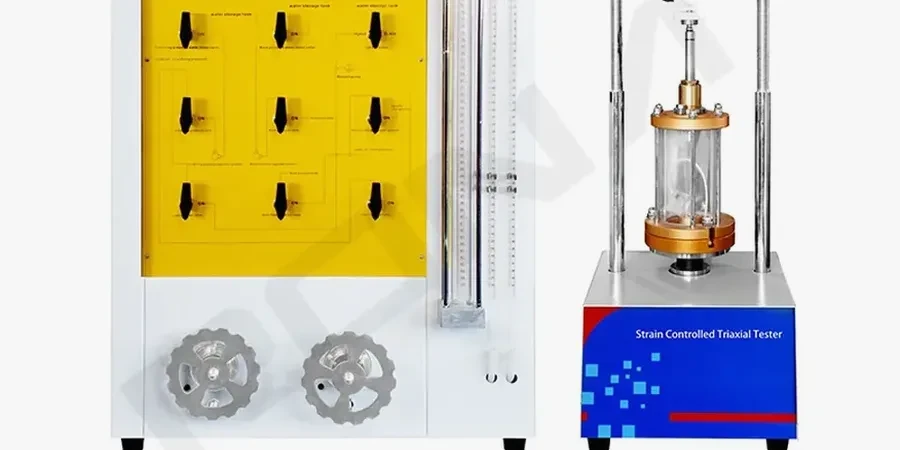
A typical triaxial test sequence in our laboratory begins with a carefully trimmed specimen mounted inside a triaxial cell, where a latex membrane isolates the sample from the confining fluid while a load frame applies axial deformation at a controlled strain rate. In Upper Hutt, the most common failure mode we help clients avoid is an undrained bearing failure in low-permeability silts that sit beneath stiffer gravel layers, a scenario that standard SPT correlations can miss. When the triaxial test reveals a friction angle of 28 degrees instead of an assumed 34, the difference in allowable bearing pressure can be enough to trigger a costly foundation redesign midway through construction. Another frequent concern is the stability of cut slopes in weathered greywacke residual soils, where the effective cohesion intercept measured in a drained triaxial test directly feeds into limit equilibrium analyses. Skipping this stage and relying on conservative empirical values often leads to over-designed retaining structures that inflate the earthworks budget. The triaxial test gives the design team a defensible, project-specific strength envelope that stands up to peer review and council consenting, particularly when the site lies within a mapped paleochannel or an area of variable fill.
Our services
We structure triaxial testing campaigns to match the design stage, from preliminary CU tests for feasibility studies through to full drained strength envelopes for detailed design and peer review.
Consolidated Undrained (CU) Triaxial with Pore Pressure Measurement
The standard test for evaluating effective stress strength parameters in fine-grained soils. We run three specimens at different confining pressures and report the Mohr-Coulomb envelope together with stress path plots.
Consolidated Drained (CD) Triaxial Testing
Used for long-term stability analysis where pore pressures have dissipated. Essential for cut slopes in residual soils and for retaining wall design in Upper Hutt's silty gravel formations.
Multi-Stage Triaxial Testing
A practical option when undisturbed sample recovery is limited. Shearing a single specimen in successive stages reduces sample quantity requirements while still producing a strength envelope suitable for preliminary design.
Frequently asked questions
How many triaxial tests does a typical Upper Hutt project need?
Most site investigations in the Hutt Valley specify a minimum of three CU triaxial tests per distinctive soil unit to define a statistically meaningful strength envelope. For a single residential cut-and-fill site one set of three may suffice, whereas a commercial basement excavation often requires six to nine specimens covering the main foundation strata.
What do triaxial testing services cost in Upper Hutt?
A triaxial testing program typically ranges from NZ$2,730 to NZ$4,930 depending on the number of specimens, test type (CU, CD, or UU), and whether multi-stage shearing is appropriate. The final quote reflects the confining pressure range and the need for back-pressure saturation in low-permeability silts.
Can you test both undisturbed and remoulded samples?
Yes. Undisturbed samples taken from Shelby tubes or block samples preserve the in-situ structure and are preferred for CU and CD testing. Remoulded specimens compacted to a target density are used when evaluating fill materials or when comparing intact versus remoulded strength for slope stability back-analysis.
How long does a triaxial test program take?
A standard CU triaxial program on three specimens typically requires seven to ten working days from sample extrusion to final reporting. Drained tests run longer because the shearing stage must be slow enough to prevent excess pore pressure buildup, sometimes extending the schedule to two weeks for low-permeability silts.
Is the triaxial test required for liquefaction assessment?
Cyclic triaxial testing is one method for liquefaction assessment, but for most standard projects in Upper Hutt we recommend starting with CPT-based or SPT-based empirical methods first. Cyclic triaxial becomes relevant for major infrastructure where site-specific cyclic resistance curves must be developed for performance-based design.