The difference between a site in Trentham and one in Birchville can be night and day. In Trentham, you might hit dense gravels within a couple of metres—great for passive resistance. Head north to Birchville and the alluvial silts change the game entirely, often demanding active, post-tensioned anchors to get the load transfer you need. We’ve been designing ground anchors across Upper Hutt long enough to know the local geology doesn’t read the textbook. The Hutt River’s floodplain deposits create variable profiles that punish generic designs. That’s why our approach starts with understanding exactly what’s beneath the surface before we specify a single strand. We often combine anchor design with a site-specific ground investigation to nail down the bond zone capacity before finalising tendon lengths.
A passive anchor needs movement to work. An active anchor prevents it. That distinction saves walls in the Hutt Valley.
Methodology applied in Upper Hutt
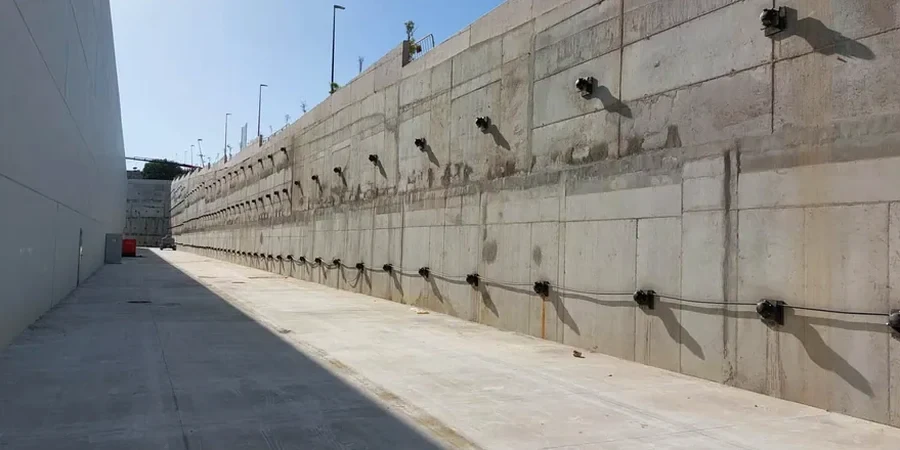
Critical ground factors in Upper Hutt
Upper Hutt’s post-war expansion pushed housing onto hillsides that earlier generations would have avoided. The 1970s subdivisions along the western hills cut into weathered greywacke and loess, creating benched slopes that have been slowly creeping ever since. A retaining structure here without properly designed anchors isn’t just a compliance issue—it’s a legacy liability. We’ve investigated sites where undocumented fill placed in the 1980s was later excavated for a basement, and the temporary batter failed because no one had accounted for the perched water table. Anchor corrosion is another silent threat in these older fills. Without double-corrosion protection, a tendon can lose significant cross-section in under a decade. Our designs specify encapsulated strands with factory-bonded sheathing for any permanent anchor in fill or aggressive soil. We also mandate water testing of anchor holes in the hillside suburbs to check for interconnected groundwater pathways that could reduce grout confinement.
Our services
We deliver anchor design from initial feasibility through to construction monitoring, focused on the ground conditions that matter in Upper Hutt.
Active Strand Anchor Design
Full design package for post-tensioned anchors including free length calculation, bond zone capacity assessment, and lock-off load specification for retaining walls and slope stabilisation.
Passive Bar Anchor Systems
Design of self-drilling and grouted bar anchors for temporary excavation support, rock slope reinforcement, and tie-back applications where displacement is tolerable.
Anchor Testing and Verification
On-site proof testing, extended creep testing, and lift-off testing to NZS 4404. We supervise stressing and review load-extension data against design predictions.
Frequently asked questions
What’s the difference between active and passive anchors?
Active anchors are tensioned after installation to apply a predetermined force to the structure—they prevent movement. Passive anchors only develop resistance once the ground or structure deforms enough to mobilise the reaction. In Upper Hutt’s silty soils, we tend to specify active anchors where movement tolerance is tight, such as adjacent to existing buildings or roads.
How long do ground anchors last in Upper Hutt conditions?
A properly designed permanent anchor with Class I corrosion protection should last 50 to 100 years. The key is matching the protection system to the ground aggressivity. In the weathered greywacke common on Upper Hutt hillsides, we use factory-bonded double-corrosion protection as standard. Temporary anchors for construction phases are designed for a 2-year service life.
What does anchor design and installation cost per anchor?
For a typical project in Upper Hutt, installed and tested anchors range from NZ$1,510 to NZ$7,100 per anchor depending on length, load capacity, and corrosion protection class. A permanent strand anchor in soil costs more than a temporary bar anchor in rock. We provide a firm quote after reviewing the geotechnical investigation data.
Do you handle the consent process with Greater Wellington Regional Council?
We prepare the Producer Statement – Design (PS1) and Construction Review (PS4) documentation required for building consent. Our designs reference NZS 3404 and the NZGS Anchor Guidelines, which are accepted by council engineers. We can also support resource consent applications if the anchor zone extends beyond the property boundary.