Upper Hutt’s growth along the Hutt River corridor has pushed development onto thick sequences of post-glacial alluvium. Gravels dominate the higher terraces, but the lower flats hold interbedded silts and sands that complicate bearing capacity assumptions. In our experience, the key is matching the foundation type to the specific terrace deposit—what works at Trentham often fails at Totara Park without adjustment. A CPT test run through the softer near-surface layers gives a continuous strength profile that no borehole log can match. When the profile shows dense gravel within 2 metres, we refine the shallow foundation design directly from the cone resistance and sleeve friction. For sites with deeper soft zones, we often recommend supplementing the investigation with a test pit to visually confirm gravel clast size and matrix content before finalising the bearing pressure.
A pumice-rich alluvium can lose 40% of its bearing capacity under load unless the friction angle is corrected per NZGS guidelines.
Methodology applied in Upper Hutt
The Terrace gravels at Upper Hutt show SPT N-values above 30 below 2 metres, allowing bearing pressures of 200 to 300 kPa for strip footings on competent material. But the crust is thin. Over-excavation is common. We specify a subgrade inspection by the geotechnical engineer before steel is placed—always. On sloping sites backing onto the Akatarawa foothills, we integrate the foundation design with a slope stability assessment to confirm the setback from the crest is adequate under seismic conditions.
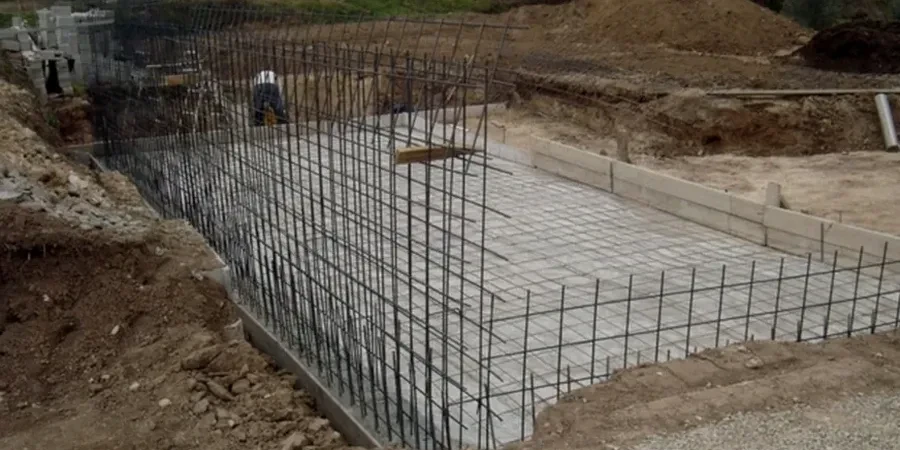
Critical ground factors in Upper Hutt
Upper Hutt sits 30 kilometres northeast of the Wellington Fault and experiences a seismic hazard dominated by shallow crustal events. A 0.40 zone factor means the ultimate limit state check for bearing capacity under earthquake loading often governs the design, not the static case. Liquefaction of the Hutt River silts is the primary risk. Post-liquefaction settlement can exceed 50 mm, which destroys a shallow foundation not designed for it. Our design process includes a liquefaction severity assessment using CPT data, and where the Factor of Safety drops below 1.2, we either deepen the founding level or switch to ground improvement. The 2016 Kaikoura earthquake reminded everyone in the Wellington region that soft soil amplification is real. At Upper Hutt, the deep alluvial basin traps seismic waves and amplifies long-period motion. A shallow foundation on a stiff gravel raft may still perform well, but the analysis has to account for the basin effect explicitly.
Our services
A shallow foundation in Upper Hutt is never a generic detail copied from a manual. Each site gets a design tied to the specific alluvial profile. These are the services we provide.
Bearing capacity analysis
Ultimate and serviceability limit state calculations for strip, pad, and raft foundations on Terrace gravels and alluvial silts, with pumice correction applied.
Settlement assessment
Immediate and consolidation settlement predictions using CPT and laboratory test data. We model the interbedded stratigraphy to catch differential settlement between gravel and silt pockets.
Seismic bearing capacity check
ULS check under earthquake loading per NZS 1170.5. Includes liquefaction-induced bearing loss and post-liquefaction reconsolidation settlement for the Hutt River deposits.
Subgrade inspection and certification
Pre-pour inspection of footing excavations to confirm bearing stratum matches the design assumptions. Scala penetrometer checks and visual confirmation of gravel matrix.
Frequently asked questions
What bearing capacity can I expect for a residential slab in Upper Hutt?
On the Terrace gravels, we typically design for 200 to 300 kPa bearing pressure for strip footings or slab-on-grade, assuming the founding level hits dense gravel with N-values above 30. In the lower-lying alluvial areas near the Hutt River, the bearing capacity drops to 100 to 150 kPa for stiff silts, and settlement often controls the design. A CPT or borehole is essential to confirm which terrace you’re on.
What does a shallow foundation design cost in Upper Hutt?
For a residential project, the geotechnical investigation and shallow foundation design package ranges from NZ$3.020 to NZ$5.340, depending on the number of test locations and whether CPT or boreholes are used. A straightforward single-storey dwelling on proven Terrace gravels sits at the lower end; a two-storey build on liquefiable silts with a raft foundation design sits at the upper end.
How do the Taupo Pumice deposits affect my foundation?
Taupo Pumice alluvium contains volcanic glass particles that crush under moderate pressure. If you calculate bearing capacity using a standard friction angle from a lab test without correction, you’ll overestimate the strength. We apply a friction angle reduction of 3 to 5 degrees, following NZGS guidance, to account for particle crushing. We also check that the pumice layer has sufficient thickness of confinement above it to prevent punching failure.