The western hills of Upper Hutt rise sharply from the Hutt River floodplain, exposing deeply weathered Mesozoic greywacke beneath variable colluvium. Designing a retaining wall here is rarely a copy-paste exercise. Seismic demand is shaped by the proximity of the Wellington Fault, and the near-surface stratigraphy shifts dramatically between the river terraces and the foothills. A wall founded on silty gravels in Trentham behaves very differently from one keyed into residual clay in Pinehaven. We approach each design by first establishing the groundwater regime and the passive resistance available in the native material. That means integrating CPT tests where access allows, or pairing borehole data with Atterberg limits to assess the shrink-swell potential of the weathered rock profile before finalizing the stem geometry.
A retaining wall is only as reliable as the drainage path behind it – in Upper Hutt's silty colluvium, hydrostatic buildup destroys more walls than the earthquake itself.
Methodology applied in Upper Hutt
Critical ground factors in Upper Hutt
Around the Mangaroa Valley, we frequently encounter colluvium that looks competent in a test pit but loses significant strength when saturated. A wall designed without a pore-pressure profile derived from in-situ permeability testing will progressively tilt forward as the rainy season saturates the backfill. The second common risk is underestimating the seismic earth pressure increment. NZS 4203 and the NZGS guidelines require a post-peak residual strength assessment when the retained slope contains pumiceous silts or loose alluvium, which is common near the river corridor in northern Upper Hutt. If the wall supports a roadway or a residential structure classified as Importance Level 3, the differential settlement between the wall stem and the approach pavement must be checked with a settlement analysis that accounts for the alluvial lens geometry – ignoring this leads to cracking at the interface within the first two years.
Our services
Retaining wall design in Upper Hutt is integrated with the site investigation and the broader geotechnical assessment. The three core service blocks below cover the typical project trajectory.
Seismic retaining wall design
Calculation of active, at-rest, and seismic earth pressure coefficients using the Mononobe-Okabe method adapted to the NZGS framework. We provide stem reinforcement schedules, toe key dimensions, and sliding/overturning checks for cantilever and gravity walls.
Drainage and backfill specification
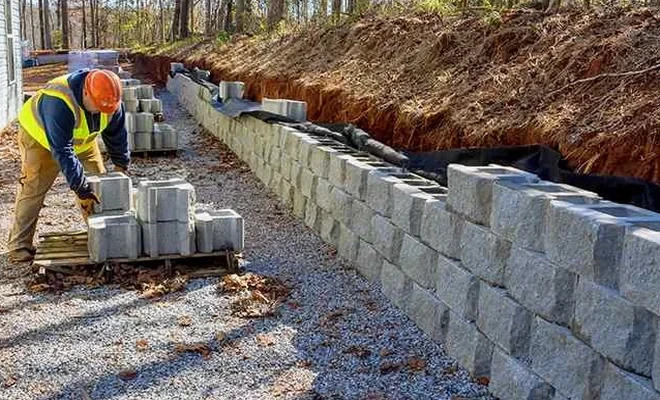
Design of the drainage system behind the wall, including geotextile filter gradation, chimney drain thickness, and weep hole spacing. We specify open-graded gravels sourced from local Hutt River quarries to control hydrostatic pressure.
Global stability and settlement analysis
Slope stability modeling of the wall-soil system using limit equilibrium methods. We evaluate the failure surface that passes beneath the wall toe and quantify the settlement of the retained fill under compaction and post-construction saturation.
Frequently asked questions
What is the typical cost range for a retaining wall design in Upper Hutt?
For a standalone retaining wall design including site-specific geotechnical parameters, the fee typically ranges from NZ$1,640 to NZ$6,340, depending on the wall height, the complexity of the subsurface profile, and whether global stability modeling is required. Walls exceeding 3 m or supporting structures at the crest fall at the upper end.
How does the Wellington Fault influence the design of a retaining wall in Upper Hutt?
The Wellington Fault's proximity imposes a higher seismic hazard factor on the site. We apply the NZS 1170.5 spectral shape and the NZGS guidelines to calculate the seismic earth pressure increment. The wall is checked for a ductile failure mechanism, ensuring the stem can yield without collapse under the design earthquake.
Can you design a wall on a Hutt River terrace with poor soil?
Yes. When the bearing stratum is loose alluvium, we either deepen the foundation to reach the denser gravels or recommend ground improvement. The vibrocompaction technique can densify the terrace gravels, or we can switch to a piled foundation with a cantilever stem, transferring the load to the competent greywacke at depth.
What drainage details do you specify for walls in Pinehaven's clay soils?
In Pinehaven's residual clay, we specify a continuous drainage chimney of clean gravel wrapped in a non-woven geotextile, connected to weep holes at 2 m centres. The backfill is a free-draining angular gravel compacted in 150 mm lifts. We avoid using the site clay as backfill to prevent pore-pressure buildup.
Do you handle the construction monitoring after the design?
We provide construction observation services to verify that the foundation excavation matches the design assumptions, check the drainage installation, and confirm the backfill compaction. This is critical in Upper Hutt, where the transition from alluvium to weathered rock can occur within a few metres laterally.