The Hutt Valley's post-glacial alluvium extends deep beneath Upper Hutt, with soft silts and organic layers reaching 15 to 20 metres near the river terraces before hitting weathered greywacke. This stratigraphy, mapped extensively in GNS Science's QMAP series, creates a genuine challenge for conventional footings—differential settlement can exceed tolerable limits in just a few months. Our stone column design addresses this head-on. By replacing a controlled fraction of the soft matrix with compacted granular columns, we accelerate drainage and transfer loads to a stiffer composite mass. The result is a ground improvement strategy that increases bearing capacity and reduces post-construction settlement, all while working within the tight vibration constraints of suburban Upper Hutt.
In Upper Hutt's soft alluvium, stone columns function as both vertical drains and load-bearing elements—reducing settlement time from decades to months.
Methodology applied in Upper Hutt
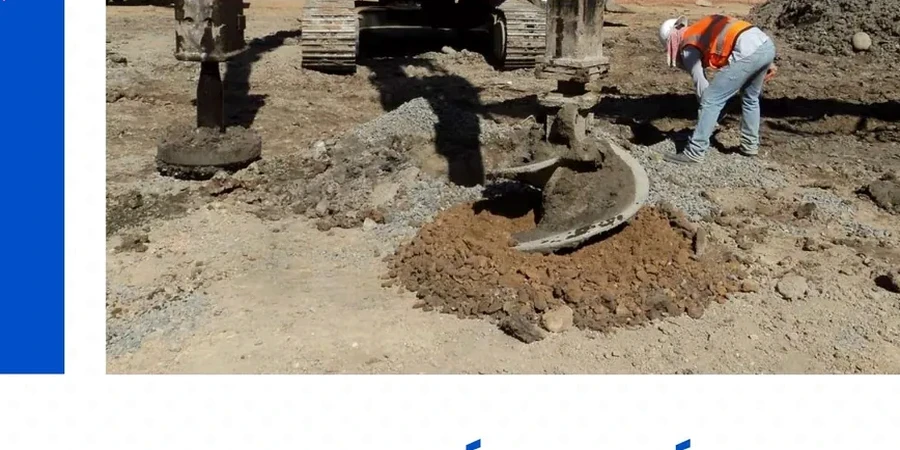
Demonstration video
Critical ground factors in Upper Hutt
The contrast between Totara Park and Riverstone Terraces illustrates the geotechnical variability across Upper Hutt. Totara Park sits on weathered terraces with moderate bearing, while Riverstone Terraces caps a deep sequence of compressible Holocene sediments prone to amplification during a Wellington Fault rupture. Installing stone columns without a proper site-specific design in these softer zones risks bulging failure at mid-column depth, where lateral confinement is lowest. We mitigate this by adjusting column length to reach a competent bearing stratum and by verifying the undrained shear strength profile through field vane tests. For sites within the Hutt City- Upper Hutt liquefaction susceptibility corridor, stone columns also serve as a dual-purpose mitigation measure, reducing both settlement and excess pore pressure build-up.
Our services
Our Upper Hutt stone column projects follow a structured workflow, from site investigation through to post-treatment verification. Each phase reduces uncertainty before construction begins.
Site Investigation & CPT Profiling
Cone penetration tests pushed to 20-25 metres to identify the compressible layer thickness and undrained shear strength profile along the Hutt River floodplain.
Priebe Method Sizing & FEM Back-Analysis
Column spacing, diameter, and depth calculated using the Priebe (1995) method, with plane-strain FEM back-analysis for embankment and raft loading scenarios.
Aggregate Specification & Fines Control
Clean stone gradation specified per NZGS guidelines to maintain permeability under high overburden, preventing silt infiltration from the surrounding matrix.
Post-Treatment Verification Testing
Verification via plate load tests on individual columns and composite modulus testing using multi-column arrays, correlated with CPT before and after treatment.
Frequently asked questions
When is stone column design more appropriate than rigid piles in Upper Hutt?
Stone columns suit sites where the soft layer is less than 20 metres thick and the structure can tolerate 25-50 mm of controlled settlement. They avoid the cost of piling rigs and pile caps while also providing radial drainage, which accelerates consolidation. For highly sensitive structures with near-zero settlement tolerance, rigid piles become the better option.
What does stone column design cost for a typical Upper Hutt residential lot?
For a standard residential lot in Upper Hutt, stone column design and installation typically ranges from NZ$2.280 to NZ$8.580, depending on column depth, replacement ratio, and access constraints. Sites with very deep soft clays or restricted rig access tend toward the upper end of the range.
How does the Wellington Fault influence stone column design in Upper Hutt?
The Wellington Fault runs close to the Hutt Valley, and NZS 1170.5 requires seismic design actions that account for near-fault shaking. We incorporate cyclic shear stress checks into the design to ensure columns remain stable under the design earthquake, preventing bulging failure and excess pore pressure accumulation.
What verification confirms the stone columns are performing as designed?
We run plate load tests on isolated columns and groups, measure the composite deformation modulus, and compare pre- and post-treatment CPT soundings. The improvement ratio in cone resistance typically exceeds 2.0 in Upper Hutt silts, confirming the design assumptions. More info.