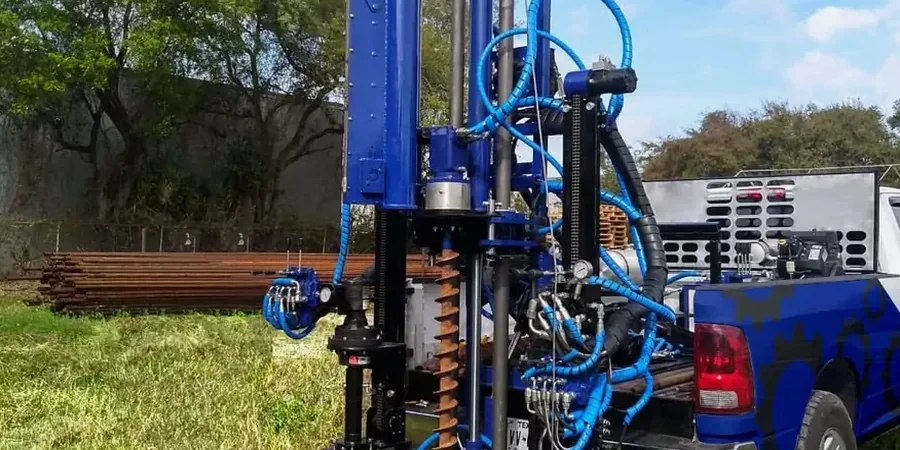
Too many foundation designs in Upper Hutt start with assumed bearing capacities that don’t match what’s actually beneath the grass. We’ve seen jobs where the geotech report arrived after the floor slab was poured, and the cost to remediate a differential settlement problem on the river terraces ran five figures. Standard Penetration Testing eliminates that uncertainty by delivering measured N-values at every metre of depth, not interpolated guesses. Our rigs mobilise across Trentham, Heretaunga, and Totara Park within a day of booking, and the hammer energy is calibrated to NZS 4402:1988 requirements so the blow counts you receive are directly usable in empirical correlations. For sites where the gravels pinch out against silt lenses, we often pair the SPT campaign with a test pit investigation to visually log the transition zones before the sampler goes in.
A calibrated SPT N-value from Upper Hutt’s gravel terraces is worth more than any textbook correlation applied blindly to the Wellington region.
Methodology applied in Upper Hutt
Critical ground factors in Upper Hutt
The Hutt Valley’s stratigraphy is dominated by fluvial gravels interbedded with discontinuous silt and clay seams that create perched water tables at depths as shallow as 1.8 metres in the Trentham area. When an SPT sampler punches through a gravel lens and suddenly hits saturated silt, the blow count can drop from 35 to 4 in a single drive interval, and if that transition isn’t logged properly, the foundation design will overestimate the bearing stratum. Compounding the risk, Upper Hutt sits within the Wellington Fault deformation zone, and the NZGS Module 4 framework requires SPT-derived cyclic resistance ratios for liquefaction triggering analysis—relying on SPT data collected without energy calibration produces false negatives that engineers cannot afford to carry into seismic design. We have encountered sites near the Hutt River where the groundwater table fluctuates 1.5 metres seasonally, and the corresponding effect on effective stress changes the N-value interpretation enough to shift a site from “liquefaction unlikely” to “requires ground improvement.” Before finalising foundation depths in the river corridor, we often review the liquefaction assessment parameters so that the SPT dataset feeds directly into a defensible triggering analysis.
Our services
The SPT is rarely the only investigation tool deployed on an Upper Hutt project—it works best when integrated with complementary tests that fill the gaps in the subsurface picture. The following services run alongside our SPT campaigns on a regular basis:
CPT Soundings
Static cone penetration testing provides continuous tip resistance and sleeve friction profiles that complement the discrete SPT intervals—especially useful in the soft silts beneath the valley floor where SPT disturbance can mask the true stratigraphy.
Test Pit Excavation and Logging
For shallow investigations on the river terraces, we excavate and log test pits that expose the gravel fabric directly, allowing bulk sampling for gradation analysis alongside the SPT depth data.
Atterberg Limits and Classification
Fine-grained layers encountered during SPT drilling are sampled and tested for liquid limit, plastic limit, and plasticity index so that the soil behaviour type can be classified under the NZGS framework.
Liquefaction Triggering Analysis
Using the corrected N60 values from our SPT logs, we run the Boulanger & Idriss (2014) and Seed & Idriss (1971) procedures to determine factor of safety against liquefaction for Upper Hutt site-specific seismic demands.
Frequently asked questions
How much does an SPT borehole cost in Upper Hutt?
For a typical single SPT borehole advanced to between 6 and 12 metres depth on an accessible Upper Hutt site, you can expect a cost between NZ$1,000 and NZ$1,420. The final figure depends on access conditions, the number of SPT intervals required, whether casing is needed to stabilise the hole through gravel, and the logistics of mobilising the rig from our Wellington base. We provide a fixed-price quote once we’ve seen the site location and the proposed borehole depths.
What depth do you typically reach with SPT drilling in the Upper Hutt valley?
On the Hutt River floodplain and terrace surfaces, we routinely reach 10 to 15 metres before encountering practical refusal in the dense gravels. In areas closer to the Akatarawa Range where the greywacke basement is shallower, refusal often occurs between 5 and 9 metres. The split-spoon sampler is driven until we achieve 50 blows in any single 150 mm increment or until the total blow count across the three drive intervals exceeds 100, whichever comes first, and we log the refusal depth precisely for pile socket design.
Are your SPT hammers energy-calibrated for New Zealand conditions?
Yes. Our automatic trip hammers are calibrated using rod-mounted accelerometers to measure the actual energy delivered to the drill string, and we report both the raw N-value and the energy-corrected N60. This calibration is essential in the Wellington region because the NZGS liquefaction assessment procedures require N60 values with a known energy ratio—uncorrected data from an uncalibrated hammer can underestimate liquefaction susceptibility by a factor of two in the silty deposits common beneath Upper Hutt.