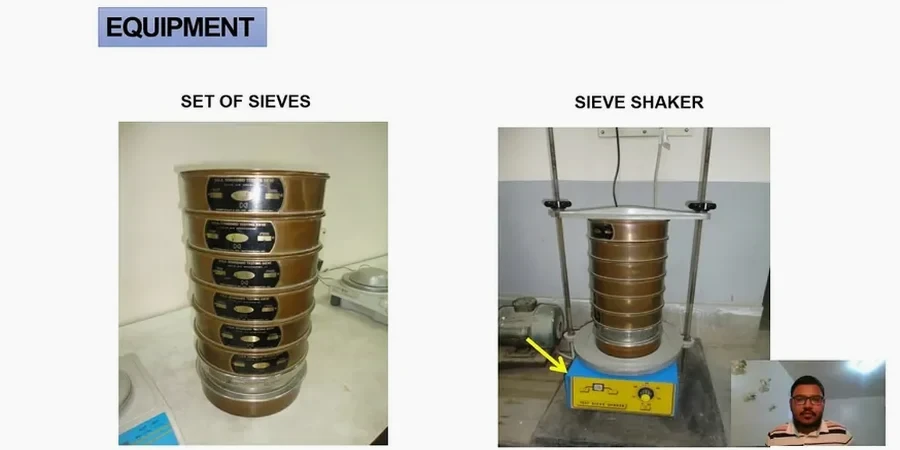
NZS 4402 sets the framework for laboratory soil testing in New Zealand, and in Upper Hutt its application is non-negotiable. The Hutt River terraces and the weathered greywacke of the Remutaka foothills produce particle size distributions that vary sharply over short distances: one borehole hits clean sandy gravel, the next hits silty clay with trace organics. A combined sieving and hydrometer analysis resolves the full curve from coarse gravel down to colloidal clay, giving the design team reliable D10, D30 and D60 values for filtration, drainage and compaction control. When the Terrace Gravel formation or alluvial silts from the Mangaroa floodplain are the foundation material, we avoid assumptions and run the full hydrometer procedure on every sample with fines fraction exceeding 12 percent. Before opening a trial pit in the Trentham area, we often cross-check the expected profile with an in-situ permeability test to link gradation to field hydraulic conductivity.
A two-metre sample from Upper Hutt alluvium can shift from sandy gravel to silty sand within 500 millimetres. Combined sieve and hydrometer analysis catches the transition that field logging misses.
Methodology applied in Upper Hutt
Critical ground factors in Upper Hutt
A cut-to-waste excavation in the Totara Park hillside hit a lens of completely decomposed greywacke that looked like competent rock in the trench wall. The contractor treated it as engineered fill and compacted it, but the grain size analysis showed 38 percent fines and a plasticity index of 14. That material failed the drainage blanket specification and had to be removed and replaced with imported granular fill. The rework cost three weeks of programme and added about $40,000 in trucking. Upper Hutt soils catch people out because the Terrace Gravel can be clean and free-draining at one location and matrix-supported with silty fines fifty metres away. Performing the hydrometer analysis on every sample with visible fines is the only way to confirm the material meets the permeability and compaction requirements of the earthworks specification before it gets placed and compacted.
Our services
Our Upper Hutt laboratory covers the full particle-size workflow, from field sample preparation through to combined-curve reporting for NZS-compliant projects.
Combined Sieve and Hydrometer
Full particle size distribution from 37.5 mm gravel down to 2 µm clay fraction, reported with NZGS classification and standard shape coefficients.
Wash Sieving and Fines Determination
Quantify the percentage passing 63 µm on washed samples before dry sieving, critical for Upper Hutt alluvial materials with variable silt content.
Gradation Envelope Compliance
Check imported fill, drainage aggregate and filter sand against specified upper and lower bound curves per NZS 4404 zone requirements.
Liquefaction Screening by Gradation
Apply the NZGS-MBIE liquefaction screening criteria using gradation curves to flag potentially liquefiable silty sand layers before committing to cyclic triaxial testing.
Frequently asked questions
What does a combined sieve and hydrometer test cost in Upper Hutt?
A full combined analysis including wash sieving and sedimentation hydrometer typically runs between NZ$160 and NZ$340 per sample, depending on the number of sieves in the stack and whether the sample requires pre-treatment for organics. Volume pricing applies for earthworks quality control programmes with five or more samples.
How long does the hydrometer analysis take?
The sedimentation hydrometer procedure per NZS 4402 requires readings at specific time intervals over a minimum 24-hour period, extending to 72 hours for material with significant clay content. We report combined curves within three to five working days of sample receipt.
When is a hydrometer required instead of just a sieve analysis?
We run the hydrometer whenever the wash sieve shows more than 12 percent passing the 63-micron screen, because the silt and clay fraction controls permeability, plasticity and compaction behaviour. For drainage design and liquefaction screening in Upper Hutt alluvium, skipping the hydrometer is not an acceptable shortcut.