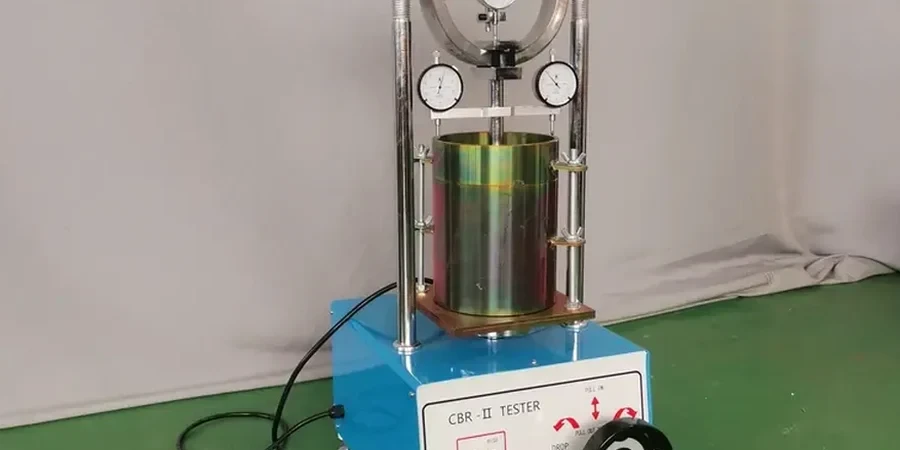
In Upper Hutt, we repeatedly encounter pavement failures where the imported basecourse looked fine on paper but simply could not handle the moisture regime of the Hutt River terraces. The difference sits in the laboratory CBR test, which quantifies the bearing capacity of a compacted subgrade or granular material under conditions that replicate field saturation. Our laboratory processes samples from River Road industrial subdivisions through to residential accessways in Trentham, delivering soaked CBR values that feed directly into the mechanistic-empirical pavement design procedures mandated by NZS 3404. Because the local geology transitions rapidly between recent alluvium, weathered greywacke, and silty loess-derived colluvium, a single assumed design CBR of 3% or 5% is rarely adequate. We complement the lab programme with grain-size distribution to confirm fines content before compaction and with an Atterberg limits assessment when plasticity of the fine fraction could compromise the soaked strength after heavy rainfall events.
A soaked CBR of 3% versus 8% changes the required aggregate thickness by over 100 mm in a standard flexible pavement — a cost and performance gap that no site inspection can close.
Methodology applied in Upper Hutt
Critical ground factors in Upper Hutt
Upper Hutt’s post-war expansion pushed housing and industrial estates onto the wide floodplain of the Hutt River, where the subgrade alternates between free-draining gravel lenses and pockets of compressible silt. The 2013 Seddon and 2016 Kaikōura earthquakes reminded everyone that the valley floor is not inert — ground shaking can rearrange the drainage characteristics of these layered soils, changing the moisture equilibrium that a pavement subgrade experiences over its design life. The laboratory CBR test becomes essential here because it quantifies strength at the worst plausible moisture condition, not at the dry, compacted state seen during construction. A subgrade that delivers CBR 20% dry can collapse to 4% soaked if the fines fraction is high and drainage is impeded. By running the full four-day soak and measuring swell, we identify materials that look competent in a hand auger sample but will degrade under service conditions, allowing the pavement designer to specify lime or cement stabilisation, additional subbase thickness, or capillary break layers before the asphalt goes down.
Our services
Our Upper Hutt laboratory is set up to process CBR specimens from the full range of materials encountered across the valley, from clean river-run gravels with low fines content to marginal silty fills that require careful moisture conditioning. Each programme is tailored to the project phase: preliminary investigations for scheme assessment, detailed design with full soaked series, and construction-phase verification testing to confirm that placed and compacted subgrade meets the design CBR assumption.
Design-phase soaked CBR programme
We prepare multiple specimens at varying moisture contents, compact to Modified Proctor density, and soak for 96 hours to produce the soaked CBR value used in Austroads mechanistic pavement design. Swelling is recorded daily.
Unsoaked CBR for construction control
When the design CBR is low and the contractor needs rapid feedback during earthworks, we run unsoaked CBR tests at field moisture content to verify that placed material meets the target density and strength before surfacing.
CBR with correlative testing package
We combine laboratory CBR with particle size distribution, Atterberg limits, and Modified Proctor compaction curves to deliver a complete NZTA M/4-compliant subgrade characterisation for roading projects.
Frequently asked questions
What is the difference between soaked and unsoaked CBR, and which one should I use for pavement design in Upper Hutt?
The soaked CBR measures bearing capacity after the specimen has been submerged in water for four days, simulating the worst-case moisture condition the subgrade will experience over its design life. The unsoaked CBR represents strength at the placed moisture content. For pavement design in Upper Hutt, where the Hutt River floodplain maintains a high water table and rainfall is evenly distributed throughout the year, we always recommend using the soaked CBR value as the design input in accordance with NZTA and Austroads practice.
How many CBR specimens do I need for a residential subdivision in Upper Hutt?
For a typical residential subdivision, we recommend a minimum of three CBR specimens per distinct soil unit encountered across the site. If the investigation reveals more than one subgrade type — for example, river gravels near the surface overlying silty alluvium — each layer must be tested separately. This usually translates to 6 to 9 specimens for a 20-lot development, ensuring statistical validity for the pavement design report.
What does laboratory CBR testing cost in Upper Hutt?
Depending on the number of specimens and whether soaked or unsoaked conditions are required, laboratory CBR testing typically ranges from NZ$190 to NZ$330 per specimen. A complete design-phase programme including compaction, soaking, and reporting for a set of three specimens falls within this bracket. We provide a fixed quote once we know the number of soil units and the required testing conditions.
Can the laboratory CBR test be replaced by in-situ DCP or Scala penetrometer testing?
The DCP and Scala penetrometers provide valuable continuous strength profiles and are excellent tools for site investigation and construction control, but they do not replace the laboratory CBR for pavement design. The laboratory test controls compaction energy and moisture content, and the four-day soak replicates long-term saturation that a single day of field testing cannot. NZTA design guides require correlation between in-situ penetration data and laboratory soaked CBR values for the specific soil type, so we typically run both field and lab programmes together rather than substituting one for the other.